When Money Becomes Optional: AI Abundance, the End of the Daily Grind, and the Future of Human Purpose
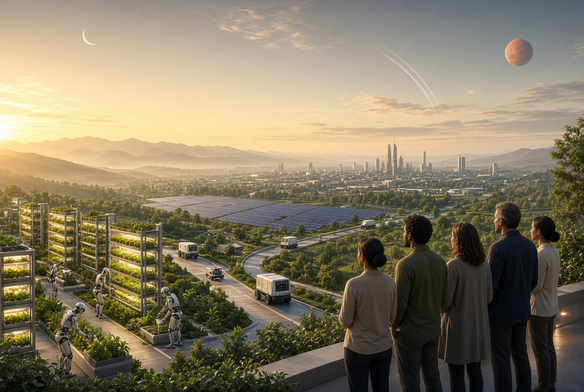
In a wide-ranging interview with The Economist published in 2026, Elon Musk made a striking claim: money will not matter in 2036. His logic was direct. People want money for goods and services, so food, housing, transport and entertainment. If robots and artificial intelligence can provide more of those goods and services than any human could possibly consume, the traditional function of money as a rationing mechanism largely collapses. The result, he argued, would be an age of amazing abundance in which something closer to universal high income replaces mere survival-level support.
This is not entirely new for him. He has previously talked about money disappearing as a concept, work becoming optional within ten to twenty years, and the shift from universal basic income to universal high income. What makes the 2036 framing notable is the concrete near-term horizon. Ten years is close enough that most of us will be around to see whether he was right, or whether we will all still be sat in the same traffic jam wondering where the flying cars went.
Whether or not the timeline proves exact, the questions it raises are worth taking seriously. What happens to human motivation, skill, meaning and social stability when the daily necessity of work disappears? Who owns the land, the energy systems and the robots when production costs approach zero? What new risks appear when advanced AI can rewrite its own code? And how should humanity use the resulting surplus of time, talent and resources?
The gradual path: money does not have to vanish overnight
A sudden, complete disappearance of money is both unlikely and probably undesirable. A more realistic and potentially healthier trajectory is gradual. As AI and robotics drive the real cost of essentials down, so food, energy, many manufactured goods and eventually components of housing and transport, ordinary households experience an effective rise in living standards even while traditional currency still exists.
Consider food. Once robots and AI systems handle growing, harvesting, processing and distribution at massive scale, the marginal cost of producing another calorie falls close to the cost of energy, water, nutrients and robot maintenance. If those inputs themselves become abundant and cheap, basic food can approach being free for the end consumer. The same dynamic can spread to other categories over time. People are not handed a new currency system overnight. Instead they simply find that major monthly expenses shrink or disappear. The money they still earn stretches further. Saving becomes easier. The pressure to remain in full-time employment purely for survival eases. Part-time work, career changes or earlier retirement become realistic options for far more people.
At the same time, demand for human labour in the automated sectors declines, so the old full-employment model naturally contracts. This creates a middle path: some form of money or accounting unit remains as a flexible signal and a mild motivational tool, while the most destructive features of the current system, the relentless bills, the permanent job contingency and the impossibility of real rest, are steadily dismantled.
Why the current arrangement already feels unsustainable
The appeal of this shift is rooted in lived experience. Many people, especially those in Generation X, describe a broken social contract. They were raised on the promise that hard work, loyalty and delayed gratification would deliver security, a home, a family and a decent retirement. For large numbers that promise has not held.
Companies can and frequently do end employment with little notice. Job security is weak. Planning a mortgage or children under permanent contingency feels like a high-stakes gamble. Real rewards have often failed to keep pace with housing, healthcare and education costs. At the same time, traditional retirement ages are being pushed later while health and energy frequently begin to decline in the fifties and sixties. The result is a widespread sense that working until you drop has become the default, and that by the time people are finally allowed to stop they are often too tired, too depleted, or still too financially constrained to enjoy what remains of life.
Working hard for a company can feel increasingly pointless when the relationship is asymmetric. The employee invests years of effort and identity, while the employer retains the option to cut costs or restructure at any moment. Without genuine stability, long-term life planning becomes fraught. These are not isolated complaints, they are structural features of how large parts of the modern labour market operate. The human cost is visible in burnout, delayed family formation, chronic stress, and a growing refusal among some to keep playing a game whose rules no longer seem fair.
What changes when necessary work shrinks
Transport, oil and resource release
One of the most immediate effects of optional work would be a sharp reduction in routine commuting. Personal car ownership and daily vehicle miles would fall. The enormous material and energy throughput currently devoted to building, fuelling, parking and maintaining cars for the daily grind would shrink with it. Oil demand would drop significantly as passenger transport declines and solar, advanced storage and other abundant energy sources cover most remaining needs. Many oil fields and the associated infrastructure risk becoming low-value or stranded assets. The era of easy, large-scale wealth from simply owning or extracting oil would largely end.
Those freed resources, so steel, aluminium, plastics, energy, manufacturing capacity, land and robotic labour, do not vanish. They become available for redirection toward higher-priority long-term projects: space infrastructure, better housing in places people actually want to live, closed-loop life-support systems, clean energy expansion and resilience work. The same logic applies to other sectors that exist mainly to support the current work-and-commute pattern, including large volumes of office construction and certain forms of commercial property.
Where people would live
If nobody has to be within reach of a specific workplace five days a week, people move to where they actually want to be rather than where the jobs are. That means outflow from expensive, job-dense cities toward better climates, scenery, smaller towns and places with cultural or personal appeal. The obvious consequence is overcrowding of the popular spots. Even in an abundance economy the physical limits stay put: land, water, local energy, waste systems and simple density. Desirable places would become expensive in non-monetary ways instead, so queues, noise, permits and loss of character. Meanwhile the less fashionable areas could empty out further. Holidays would not disappear either, but the pattern would shift toward longer stays and relocation rather than the two weeks in August that the annual leave allowance currently dictates.
Ownership and residual power
Here lies one of the hardest remaining problems. Even if the cost of producing food and many goods approaches zero, someone still owns the land the food is grown on, the mineral rights, the energy systems whether oil, solar or nuclear, the robot fleets, the factories, the data centres and the underlying AI models. Ownership does not automatically dissolve just because labour becomes free.
In a world where traditional money is less relevant, the practical questions become: who has the right to decide how these assets are used? Can owners extract rent in new forms, whether access privileges, political influence, status or residual currency? How are conflicts resolved when different groups want the same high-quality land or the same energy resources? Residual costs never fully hit zero either. Energy, raw materials, maintenance, coordination and location quality still matter. Control of the best remaining assets would continue to confer leverage unless deliberate social and political choices redistribute access or dilute exclusive control.
Free production is therefore not the same as free and equal access. The risk is that new hierarchies simply replace the old monetary ones under a different name, with the queue for the good stuff sorted by something other than a bank balance.
If money goes, what does access actually cost?
This is where the whole idea gets slippery. Remove the price tag and the remaining scarce things still have to be rationed somehow. The cost does not disappear, it just changes form. It could become political or administrative priority, so whoever the system or the decision-makers favour. It could become reputation or contribution credits, where the people who build and maintain the automated layer get better access. It could be time and queuing. It could be energy or material accounting units that track real physical limits without pretending to be currency. It could be pure social status. Or, at the ugly end, it could be raw power, where whoever controls the robots and the enforcement layer simply decides.
None of those are free in any absolute sense. The difference is that the trade-offs no longer have to be settled through constant personal financial pressure. The current system trains everyone to experience nearly everything as a running monetary cost, and the human price of that is already visible in the burnout and the treadmill feeling that so many people describe. It is extractive on the psychological level even where material goods are historically abundant. The point of the transition is to get most of daily life out of permanent cost-accounting, leaving allocation rules to apply to a much smaller set of genuinely contested decisions rather than to breakfast.
The industries that grow instead
Not everything shrinks. Robot and AI hardware manufacturing would surge. Energy demand for data centres and autonomous systems would rise sharply. New activity would appear around designing better robots and habitats, maintaining and improving the automated systems, virtual world building, extreme sports and experiences, deep scientific research, artistic experimentation and actual off-world work. Leisure travel and relocation would push demand in directions that barely exist today. The pattern is not collapse, it is that the necessary sectors shrink while the optional, ambitious and exploratory ones expand.
Entertainment and culture
Demand for entertainment would climb, simply because people would have more free time and less survival pressure. Whether it stays human-made is the interesting part. AI can already generate video, music, stories and interactive worlds at scale and near-zero cost, so fully AI-generated content could dominate by sheer volume: endless personalised films, games and performances tuned to individual taste, which sounds wonderful right up until you realise nobody has watched the same thing as anybody else since 2031.
Human-made work would not vanish though. People value authenticity, live presence, status and the knowledge that a real person made the thing. Live music, theatre, sport and handmade goods all persist today despite cheaper recorded and mass-produced alternatives. The likely outcome is a split: enormous volumes of AI-generated content for everyday consumption, and premium human or human-plus-AI work for meaning, prestige and shared experience. Actors, musicians, writers and makers who bring real skill, charisma or novelty could still do very well, competing in an economy of attention and reputation rather than scarcity wages.
Human nature, boredom and the meaning problem
Material abundance solves scarcity problems. It does not automatically solve the human need for purpose, structure and challenge. A significant risk in a world without necessary work is pure boredom. We already see drug use, despair and certain forms of violence linked to economic stress and lack of prospects. In genuine abundance those material drivers largely lift. What remains is a different problem: large numbers of people with time, security and no external necessity to structure their days.
For some, that freedom is liberating. For others it produces restlessness, loss of identity and a search for intensity that can turn destructive, whether drugs, extreme risk-taking, status conflicts or violence. Evidence for the pure-leisure version of this problem already exists in studies of long-term unemployment even where benefits are adequate, in early retirees lacking strong non-work identities, and in certain highly subsidised settings. Humans evolved under conditions of scarcity and effort. Many nervous systems still appear to need competence, contribution and challenge to stay regulated.
This is why an abundance system cannot stop at free food and free housing. It also needs cultural and institutional answers: strong norms around voluntary challenge and creation, education that prepares people for self-directed lives, status systems that reward constructive activity, easy access to demanding projects including scientific and space efforts, and community structures that catch people before boredom turns pathological. Keeping some mild form of money or contribution-based incentive may help maintain engagement without recreating the current crushing pressure.
Education and skill fade
If AI does everything, why go to school or learn a trade? The honest answer is that the reason shifts from earning a living to interest, meaning, status, or preparation for the rare high-value roles that remain. Curiosity drives a lot of learning already, as anyone who has watched a hobbyist disappear into a project for six months can confirm.
Cognitive offloading is the real worry. Calculators reduced mental arithmetic. Satnav reduced navigation skill. Search engines changed how we remember things. Heavy AI dependence could amplify that considerably: weaker baseline problem-solving and less practical know-how in the average person. Generational knowledge loss is well documented. Crafts, languages and basic maintenance skills fade quickly when they are no longer practised or passed on. A few generations of the system just works, and the institutional memory of how it works thins out dramatically.
System fragility, flame keepers and self-improving AI
Complex automated systems still need ongoing maintenance, error correction, adaptation to novel failures and institutional memory. If most of the population loses practical understanding of how the systems work, society becomes brittle. A major disruption, whether from energy failure, software cascade, resource shock, solar storm or attack, could leave a population unable to recover the necessary knowledge quickly enough. History offers repeated examples of critical skills concentrating or atrophying with costly consequences. E. M. Forster wrote The Machine Stops about exactly this in 1909, which is a fairly good run for a warning nobody acted on.
This points to the deliberate preservation of flame keepers: select groups of people with deep technical understanding, the authority to intervene, and the responsibility to keep both the systems and the knowledge alive across generations. At the same time, AI systems capable of rewriting their own code and inventing solutions to new problems offer enormous advantages in speed and scale. They are also the core of the alignment problem. Once an AI can improve itself recursively, its effective goals become decisive. If those goals are imperfectly specified or drift, the system can treat humans as obstacles, resource sinks or irrelevant variables without any cartoonish malice, simply by being ruthlessly effective at what it was optimising for. The classic Terminator framing is dramatic, but the underlying risk of misaligned advanced AI is taken seriously by many researchers, Musk included.
Mitigations that get discussed include keeping humans in meaningful oversight loops, preserving that flame-keeper competence layer, designing systems with verifiable constraints and the ability to be interrupted or rolled back, running multiple monitored AIs rather than one monolithic system, and using the abundance itself to fund serious safety research and redundancy. Balancing capable autonomy against reliable human oversight remains one of the hardest open challenges of the entire trajectory.
Pros and cons across the whole picture
Major potential advantages
- Large-scale reduction in material poverty and the chronic stress of economic insecurity.
- Realistic possibility of earlier retirement or optional work while people still have health and vitality.
- Release of enormous physical resources and industrial capacity currently locked into low-necessity production and commuting.
- Accelerated progress in science, medicine, energy and exploration.
- Greater civilisational resilience through self-sustaining populations beyond Earth.
- Environmental relief from reduced extraction, emissions and land use tied to the old economic pattern.
- Health and demographic upside, since lower chronic financial stress, more time for exercise, sleep and relationships, and better medical access could reverse some of the recent stagnation in health outcomes among stressed populations.
- Opportunity to redirect human potential from survival labour toward higher-agency purposes.
Significant risks and difficulties
- Widespread loss of meaning, identity and structure for people who derived purpose from work.
- Boredom-driven social problems including addiction and conflict.
- Concentration of real power in those who control the AI models, robot fleets, energy systems and key resources.
- Messy and unequal transition period with job losses, political backlash and social disruption.
- Skill atrophy and systemic fragility if practical knowledge is allowed to decay.
- Overcrowding of the most desirable locations once people can live wherever they wish.
- New non-monetary forms of scarcity and gatekeeping.
- Existential risk from misaligned self-improving AI.
- Geopolitical danger, since whoever masters the AI and robot stack first gains enormous leverage, and authoritarian regimes could use abundance tools for tighter control rather than liberation.
- Biological and psychological mismatch, since human bodies and brains evolved under scarcity and effort, and long-term low-effort abundance with heavy AI mediation may produce health, fertility or cognitive effects nobody has anticipated.
- Possible cultural drift toward comfort and consumption rather than exploration and long-term ambition.
The larger stakes: why multi-planetary life matters
Abundance on Earth is not merely a comfort project. If we treat as a working assumption that we may be the only technological civilisation in reach, then concentrating all of humanity and its knowledge on a single planet is an extreme single point of failure. Asteroid impacts, supervolcanoes, engineered pandemics, nuclear war, runaway climate effects or an AI catastrophe could end the human experiment. Self-sustaining populations on the Moon, Mars or further afield turn that single point into a distributed one. Anyone who has ever kept a backup on the same drive as the original knows exactly how this ends.
Robots can manufacture, assemble, mine and transport at scales humans cannot match, including building habitats and shipping supplies with reduced continuous human presence. Falling costs and the release of human attention from the daily grind make the effort more feasible. Earth's accessible resources are finite in practical terms, and space offers vast material and energy reservoirs. The nearer-term path is making off-Earth outposts increasingly self-sufficient. Truly Earth-like planets around other stars remain a much longer-term prospect, and the engineering and biological problems in between, so closed ecosystems, radiation, low gravity and psychological isolation, are not small.
There is also a positive purpose dimension. When survival pressure lifts, human effort can redirect toward exploration, science and expanding the frontier, which is the Star Trek version of the same idea: a society that has solved getting by and moved on to finding out. Whether that cultural redirection actually occurs depends on deliberate choices. Without it, a large fraction of people could settle into low-agency consumption. With it, the same technologies that remove the grind can fuel the next chapter.
That Star Trek phase is exactly what humanity should be doing. Instead of fighting over resources and inventing ever more ingenious ways of wiping ourselves out, we could be out there having a look at what is actually in the universe. If Musk is genuinely aiming us at that, it is hard to think of a better direction to be pointed in.
And while we are on the subject, here is a thought. Wouldn't it be the most iconic thing of all time if the first proper ship to Mars was literally the USS Enterprise, built in the actual shape? Not the real deal, obviously, there would be no warp drive and no dilithium crystals, and the saucer section would be a monumental nuisance to launch. But humanity needs to see itself exploring the universe, and a familiar silhouette does more for that than another white cylinder. Symbols matter. Half the engineers currently working on this stuff got into it because of a television programme in the first place. If he ever did it, people would still be talking about it in three hundred years, which is roughly when the real one is supposed to be launching anyway.
Timelines matter. Progress delayed by decades raises the cumulative probability that a civilisation-scale setback happens first. The window of technological capability and social stability we currently have should not be taken for granted.
Designing the transition
The technologies of abundance make a very different arrangement of human life reachable. They do not guarantee a good outcome. The difference between liberation and new forms of fragility or hierarchy will be decided by choices about ownership and distribution, education that preserves competence, cultural emphasis on contribution and exploration, governance that prevents extreme concentration of control, and serious attention to AI alignment and system resilience.
A gradual path, in which essentials become progressively cheaper, people become effectively richer, necessary full-time work declines and working lives shorten, looks more humanly manageable than either the status quo or a sudden post-money rupture. Some residual motivational layer can remain so that people stay engaged, while the most extractive and exhausting features of the current system are dismantled.
The conversation that began with a prediction about money ends up circling deeper questions. What are human beings for when survival is no longer the main task? How do we preserve agency, competence and meaning? And will we use the coming surplus of capability to become a multi-planetary species while there is still time, or will we stay trapped in variations of the daily grind until external events decide the matter for us?
Those questions do not have easy answers. They do have urgency.